3164-6336

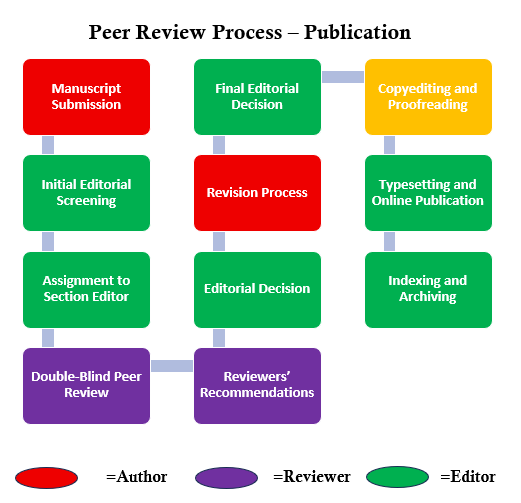
Authors submit their manuscripts through the journal's online submission system. Submissions must align with the journal’s aims and scope and follow the prescribed Author Guidelines.
The editorial team performs an initial assessment to evaluate:
Manuscripts that fail to meet these basic requirements may be rejected outright (desk rejection).
Once the manuscript passes the preliminary check, the Editor-in-Chief assigns it to a Section Editor who will oversee the peer review process.
Reviewers assess the manuscript based on the following criteria:
Upon completing the review, reviewers provide one of the following recommendations:
The editor evaluates the reviewers’ comments and decides whether the manuscript should be:
All comments are anonymized and forwarded to the authors through the journal system.
Authors are required to revise their manuscripts in accordance with reviewers' feedback and submit the revised version along with a detailed response letter addressing each comment. The revision deadline is usually set within 1–3 weeks, depending on the level of revision needed.
If major revisions were requested, the revised manuscript may be re-evaluated by the original reviewers (re-review) to ensure the concerns have been adequately addressed.
After revision and (if applicable) re-review, the editor issues a final decision:
Accepted manuscripts undergo:
Authors must approve the final version prior to publication.
The manuscript is typeset according to the journal’s layout and scheduled for publication in a specific issue. A Digital Object Identifier (DOI) is assigned to each published article.
Published articles are indexed by relevant indexing partners (e.g., Google Scholar, DOAJ, CrossRef, Scopus if applicable) and digitally archived for long-term access and preservation.
3164-6336